At the start of the quarter, I didn’t expect the class to be public relations focused. I have very little experience with public relations, so I was glad to learn about how to develop a positive relationship with journalists from a public relations perspective, how to effectively communicate about agriculture so people understand and appreciate it, how to write a press release, and how to handle crisis communication.
I did expect to create stories about agriculture, which we had the opportunity to do with the final video. My video was about a Cal Poly masters student working to create an agroforestry plot, and I enjoyed using the video to explain what agroforestry is, how it could work in California, and learning to capture B-roll of the plot’s trees and plants that would be engaging to my audience.
In 2008, students living at the Cal Poly agriculture house flew a confederate flag and a hangman’s noose in their yard, in addition to a sign that had racist and homophobic slurs, accoridng to a New Times article. The head of the Department of Horticulture and Crop Science John Peterson confirmed that the students did hang the sign and noose, though he did not see them. He said he didn’t think the students “meant to send a message that was racially insensitive or motivated,” but failed to address that the confederate flag, noose, and racial and homophobic slurs have a history of representing and causing violence. I don’t think the College of Agriculture should have defended the students at all. They should have condemned the act, and explained the history of the confederate flag, nose, and the racial slurs and how they likely made Black and gay students feel very unsafe on campus. This would hopefully deter students from using these symbols in the future.
Peterson spoke with the students, but said that they wouldn’t receive a formal punishment, especially because the school had to consider free speech rights, according to the article. Peterson did say that the incident was “reprehensible” and didn’t reflect the department’s values, however, I think he should have apologized that the department created an environment where the students felt it was acceptable to use racist symbols.
According to the article, the students wrote in a statement, “We house members truly recognize how intolerant, insensitive, immature, and ignorant [our] actions were. These items were displayed without forethought and were promptly removed when their negative significance and connotations were realized,” however, it doesn’t appear that the students apologized for the harm caused by their actions, and I think the university should have required them to do so.
I think the College of Agriculure’s response would have been more successful if they apologized for the incident and the harm it caused to Black and gay students, and used stronger language condemning the action.
I interviewed Brandon Hurd about his agroforestry plot at the Experimental Farm on Thursday, February 24. He told me about the trees he’s going to plant, from oaks, to peaches, to elderberry trees, and we discussed how his plot mimics an oak savannah ecosystem. He also told me about his experience WOOFing — which is a program that places people to work in farms around the world. He worked at a number of sustainable farms in the United States, which inspired him to pursue sustainable agriculture and this project.
He hasn’t planted any of the plot yet, and most of the trees are small and in pots by the front gate. I shot B-roll of him pruning the trees and walking through his plot — which right now only has cover crop. I also took a few close-up videos of the trees.
I also interviewed the project advisor, professor Nick Babin. Babin explained that Hurd’s plot employs an agricultural method called alley cropping, which is when useful plants like nitrogen fixers or food crops are grown between rows of trees. We also discussed commercial forms of agroforestry, like cacao and coffee farming. Babin said he was excited to use Hurd’s project to teach students about agroforestry when it’s finished.
The animal agriculture industry is often challenged by animal rights activists. I think a major breakdown in agriculture communication is the failure to respond to accusations of animal cruelty.
For example, many animal rights groups disagree with gestation and farrowing crates. The Humane League published an article criticizing gestation and farrowing crates, writing that the “metal cage is so tight, a pig can’t even turn around.” They start the article with a photo of a pig in a crate. The lighting in the photo is dim and the pig is dirty, making it look uncomfortable and sad.
In class, however, we discussed that farrowing crates prevent the mother pigs from falling on and crushing their piglets. The agriculture industry should publish more articles about how gestation and farrowing crates are used, and how they ultimately protect pigs. These articles would be more powerful if accompanied by videos of pigs looking comfortable in the crates.
I decided to tackle the final video project on my own. I plan to focus the video on Brandon Hurd, the student manager of Cal Poly’s Experimental Farm. He joined the Environmental Sciences and Management Masters Program this year, and is developing an agroforestry plot that mimics our local oak savannah ecosystem. He’s interested in learning about how to use oak trees as a food crop, while building a plot that’s drought resistant and able to adapt to climate change.
I want to start the video with Brandon explaining what his plot looks like. He can walk us through what trees and plants he’s growing and why they’re appropriate to grow in a drought-prone area. Then it would be ideal to interview a student assistant about their experience working on the project. I’d also like to talk with Nick Babin, the professor advising the project, about how we could apply lessons from the plot to commercial agriculture.
I plan to gather B-roll of the plot, hopefully taking video of him walking through the trees, pruning the trees, and capturing close-up shots of the plants and trees he’s growing. It would be ideal to get B-roll on a day where he’s doing substantial work on the plot, such as planting the trees.
I am interested in sustainable agriculture, especially the practice of capturing carbon with soil. Grist wrote an article on the Working Lands Innovation Center, an organization researching ways to increase the soil’s capacity to absorb carbon dioxide — a greenhouse gas responsible for accelerating climate change. Reducing the amount of carbon in the atmosphere slows climate change, and increasing the amount of carbon in the soil helps crops grow, so it’s a win-win situation. According to the article, spreading pulverized rock on farmland may increase its ability to capture carbon. I think this is a very innovative and exciting approach to agriculture, and I like the idea of agriculture combating climate change in addition to feeding people.
Jour 205 focuses more on the basics of journalism than I expected. I did not anticipate the class to review grammar, AP Style, and interview and writing techniques. I’ve appreciated the refresher — I didn’t realize how many grammar mistakes I’ve been making, and I enjoyed the assignment where we interviewed a classmate. This created a low-stakes environment where I could focus on my interviewing technique without stressing over the information I was collecting. I appreciate the wide range of skills the class teaches, including writing, design, video creation and basic knowledge of the agriculture industry. I was especially interested to learn about the sharp decline in the number of Californians working in agriculture.
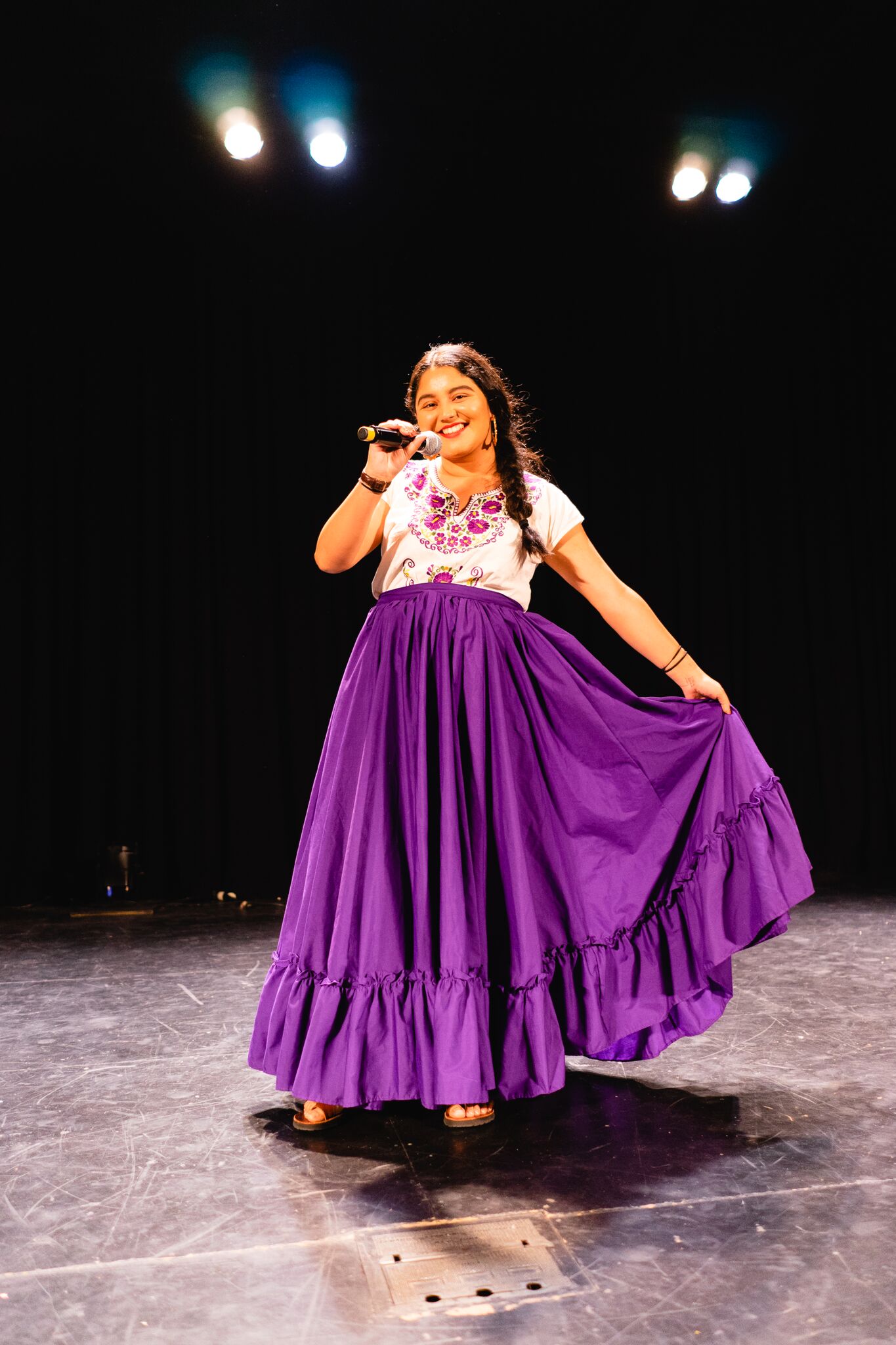
Rosa López singing at Cal Poly’s Día de Los Muertos celebration. *Photo provided by Rosa López *
Political science and ethnic studies third year Rosa López is always singing. She can be found singing soprano in her acapella group, belting mariachi at Cal Poly’s Día de Los Muertos celebration or even humming to herself while studying.
“Music is my life. I know a lot of people say that and it’s really cliche, but it’s everything to me.”
Rosa López
Like many music major transfers mentioned in previous blog posts, López found support in Cal Poly’s music community.
“Music has connected me to my peers and Cal Poly because I have That’s the Key acapella,” Lopez said. “Without that community, I don’t think I’d be connected to music nor the Cal Poly community in general. It’s basically been the grounding force in my time at Cal Poly.”
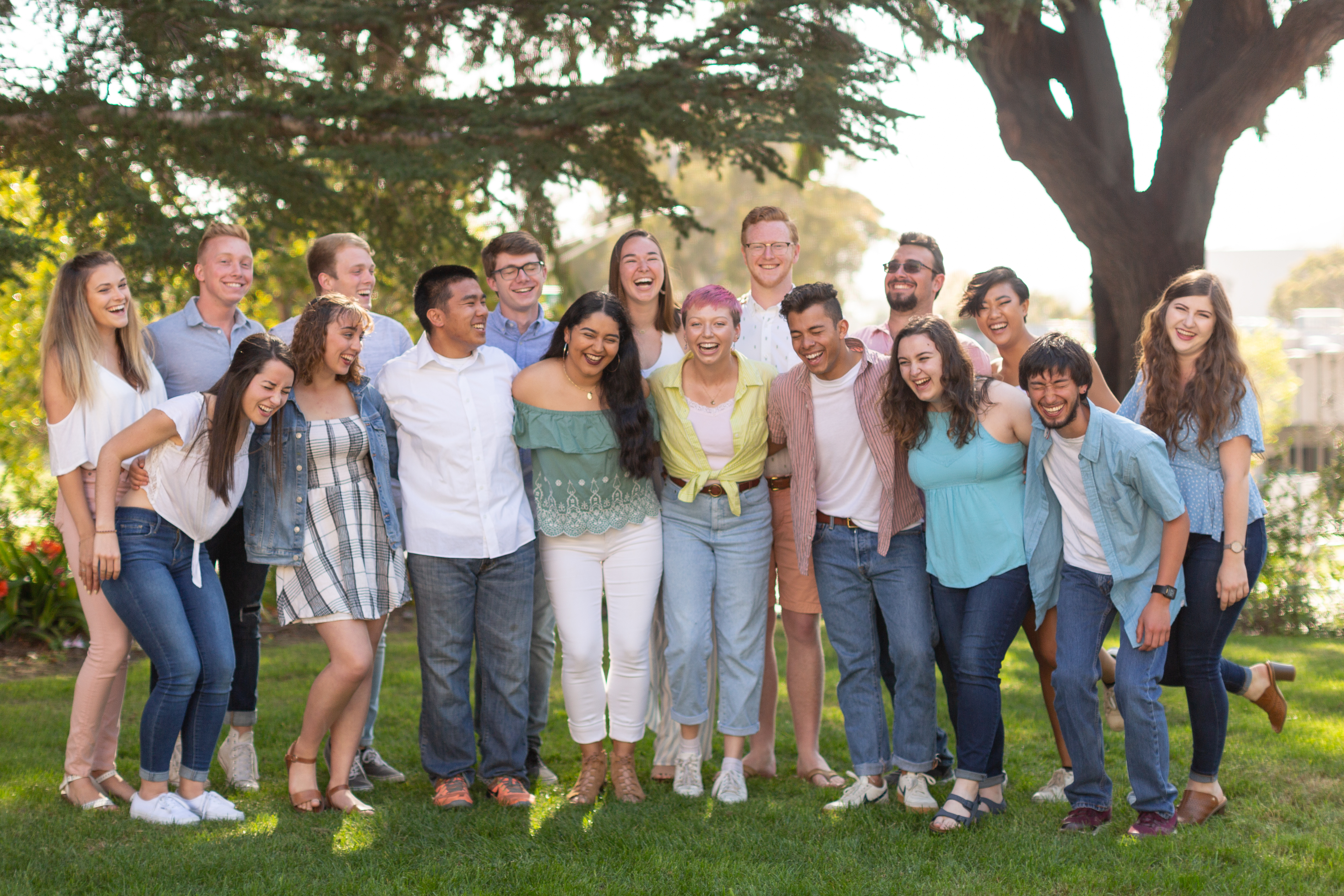
That’s the Key (TTK) is a student run acapella group on campus, and López joined the group her sophomore year of college.
That’s the Key laughing during their annual photo shoot. *Photo taken by Cody Capella*
Music and psychology sophomore Kylie Capella also found support in That’s the Key.
“The music department definitely has provided a home to me though TTK,” Capella said. “They [members of TTK] would go eat lunch with me, or even just sit with me if they weren’t eating… It’s those little things that mean a lot.”
López explained that one of her favorite parts of singing is telling a story through her voice and facial expressions, and she encourages the rest of the group to do so as well.
“Rosa always makes sure in the midst of making music we remember the purpose of the song; so our music isn’t just music, but that its delivering a special message – and a good one at that,” That’s the Key beat-boxer Brian Ebisuzaki said.
Music has been a refuge to López at Cal Poly, as she’s encountered many obstacles on her educational journey.
López arrived at Cal Poly while her identity as a Mexican-American was under attack. During her first quarter of freshman year, López found herself in the crossfire of the 2016 elections.
“[Trump] started off by announcing his candidacy by saying that all Mexicans were rapists, so coming from a daughter of immigrants and being Mexican … that’s a direct attack at who I am and who my family is,” López said. “Of course I’m going to take offense to that.”
Trump’s rhetoric followed López from the television screen to her classroom, and the day after the elections, the ramifications of Trump’s presidency became all the more real.
“When I was in class … we debriefed the election results and it was still pretty fresh and raw for me,” López said. “I remember one of my classmates saying, ‘well you know, it’s about time they get the illegals out of this country, they all need to be gone.’”
When López explained to her classmate that, by his definition, her parents immigrated to the U.S. illegally, he replied, “‘We don’t want you here.”
Outside of the classroom, there were occasions when students told López to “go back your country,” even though she was born in the United States, she said.
“[I felt] shame for being who I was, and not just being who I was, but for being visibly identified as an ‘other.’ Looking different from my peers was one thing that they could use against me if they felt hostile towards me.”
Rosa López
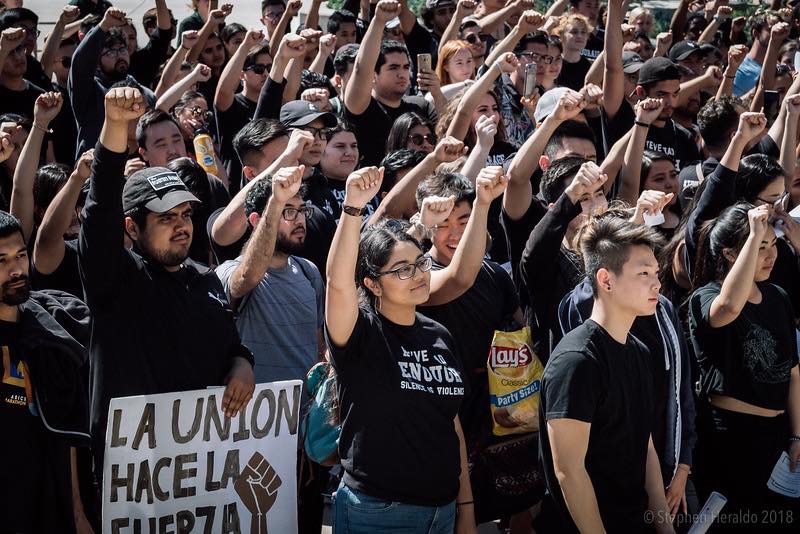
While López contemplated transferring out of Cal Poly, a friend referred her to Movimiento Estudiantil Chicanx de Aztlán (MEXA), a student run organization designed to support Latinx students in their pursuit of higher education.
“From the moment I walked in those doors … I knew that it was basically my home away from home,” López said. “Listening to the music that I grew up listening to, talking about foods that we all missed from home and just getting to bond over certain things that I knew no one else would be able to relate to. That was the big thing for me, was knowing that there were other students like me.”
López at a rally with MEXA. *Photo provided by Rosa López*
Though MEXA has provided a home for López, she recognizes that Latinx students who are not Mexican-American may feel excluded by the club.
“There’s kind of this unsaid model of being Mexican-American that you have to fit under. Like, you have to like conchas … you have to speak Spanish, you have to listen to Spanish music,” she said. “You have to have these similar experiences or you don’t fit in right, and that’s very alienating for a lot of folks.”
At a national level, MEXA has debated changing its name to make the organization more inclusive, according to a Mustang News article.
The word “Chicano,” used to be a derogatory term, but in recent years Mexican-Americans have reclaimed the word. Now, it represents their pride in their Mexican ancestry, so some club members don’t want to remove it from MEXA’s title, López explained.
Featuring Chicano in the title of the organization, however, inadvertently excludes non-Chicano Latinx students from the organization. The purpose of changing the name would be to make the club more welcoming to these students, López said, but she’s still skeptical of the name change.
“Ultimately, I don’t know how much good a name change would accomplish, mostly because you can say that you’re trying to be more inclusive, but it’s not about talk – it’s about action,”she said.
As co-chair of MEXA next year, she plans to incorporate workshops and events into the club’s schedule that reach out to both Mexican-American and non-Mexican-American Latinx students.
“What I’m hoping to do in my position next year is to do everything we can … to make those folks who would traditionally feel left out know if they wanted to find a home with us that we are there for them,” she said.
Now that López has found her home at Cal Poly, she is committed to helping other students find a home, too.
With graduation approaching, students like music sophomore Anya Restivo can’t help but wonder about the future.
Restivo transferred from philosophy to music at the beginning of spring quarter, and has been contemplating what to do with her degree. Though Restivo enjoys playing the clarinet, she’s not interested in a career on the stage; she’s drawn to instrument repair.
“I really like doing hands on things… and I feel like that’s a very practical way of doing something hands on,” Restivo said.
When Restivo graduates, she hopes to attend trade school to learn the craft. Until then, she plans to become more familiar with the clarinet.
Instrument repair technicians are often encouraged to play the instruments they fix. If a technician understands the technique used to play the instrument, they can properly advise customers how to care for their instrument to prevent further damage, according to the Berklee College of Music.
The music major is often associated with performance, but graduates can pursue a variety of careers with the degree. Along with performance, Cal Poly music graduates pursue teaching, careers in music technology and even law school, according to the music department chair Dr. Spiller.
“Many … people craft rewarding careers in music without it being in performance,” Spiller said.
The Cal Poly bachelor of arts in music is “designed for the student who wants a broad education in music,” according to the music department website.
“We have a very healthy and intensive balance of academics and performance,” Spiller said. “Students can craft their studies, and particularly their senior project, to go off on their own paths.”
While Restivo prepares for the future, she enjoys the present by playing clarinet.
Marston sings “Why God Why,” the song he’ll use to audition for the music major.
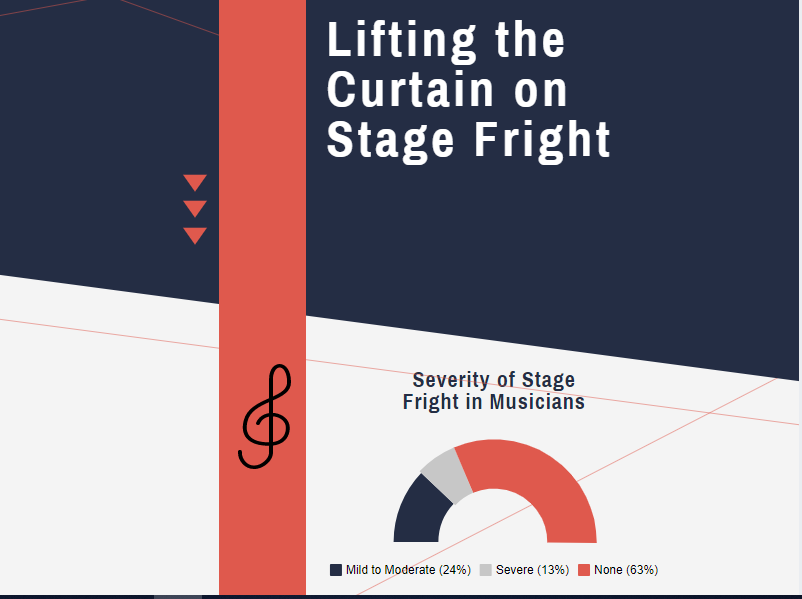
From the Grammys gilded stage to the Cal Poly choir room, performers experience stage fright. 24 percent of musicians encounter mild to moderate stage fright, and an additional 13 percent experience severe performance anxiety, according to a journal published in the US National Library of Medicine.
Even Beyoncé grapples with performance anxiety. In fact, Beyoncé was so nervous to perform with Prince at the Grammys that she forgot to give him the microphone on stage, according to Billboard Magazine.
Stage fright is correlated with perfectionism and feeling unprepared for a performance, according to the US National Library of Medicine. 91% of the survey respondents recommended deep breathing, positive self talk and holding practice performances as tools to combat stage fright.
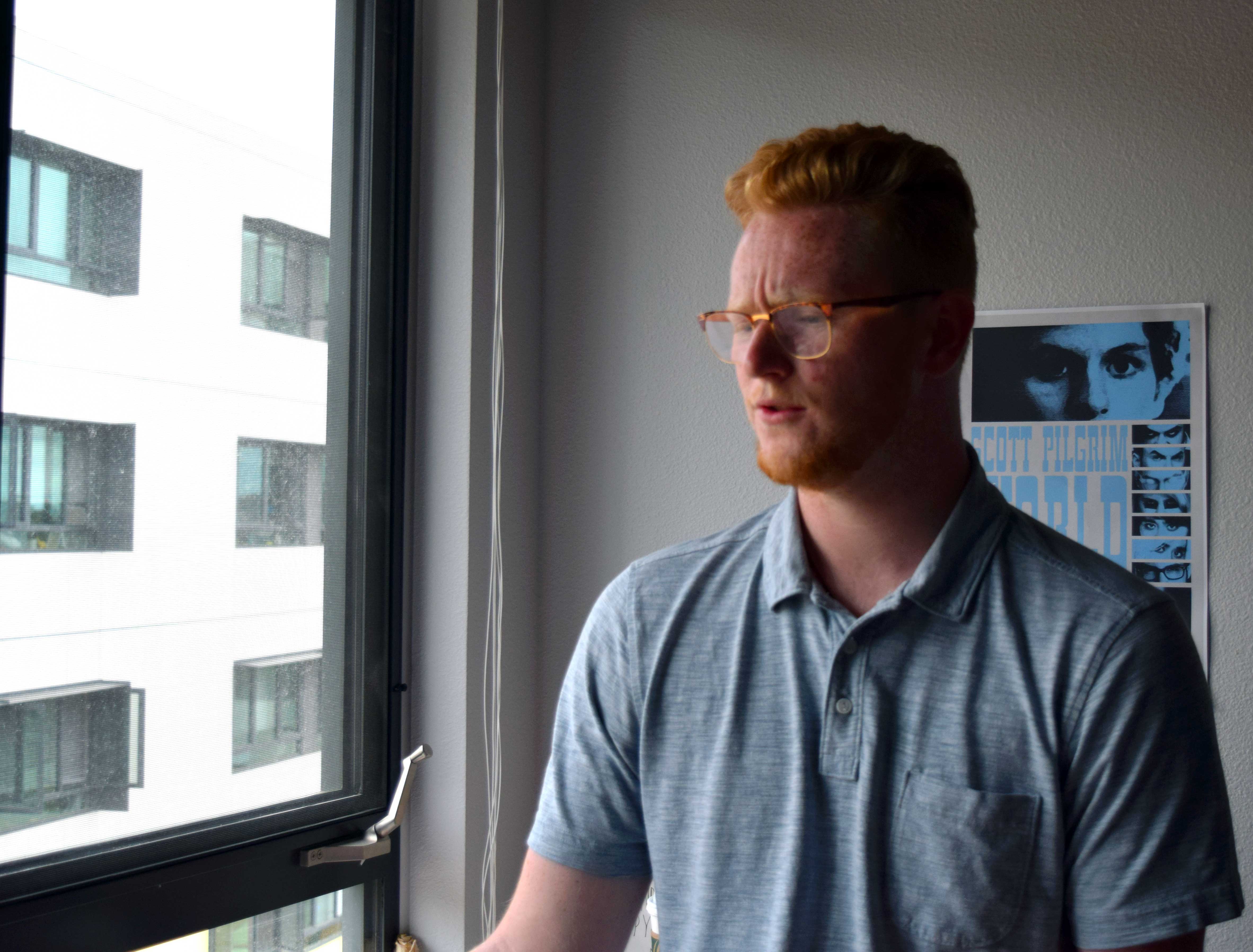
At the end of May, third year construction management major Chris Marston will audition for the music major. Marston enjoys his music classes, but has experienced his fair share of performance anxiety this year.
Learn Marston’s three tactics for overcoming stage fright here.
 Music for Your Mind